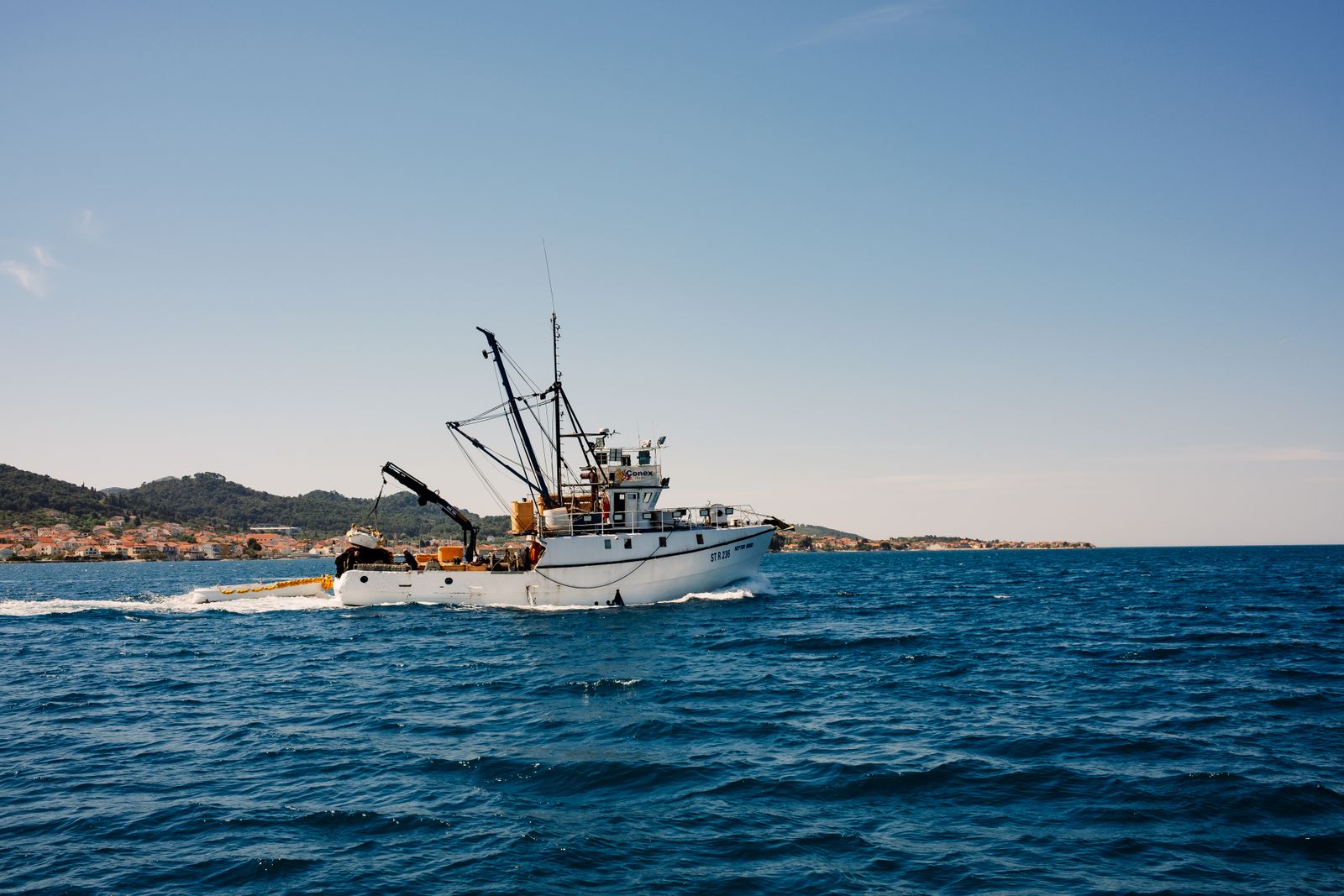
Ports across the European Union, the United Kingdom and Iceland shut to Russian mackerel carriers at the end of August, the point at which a package of North-East Atlantic Fisheries Commission countermeasures finally took legal effect. The European Commission confirmed on 28 August that the measures were in force, two months after they were agreed.
What set the sequence off was a number: 67,548 tonnes. That is what Russia allocated itself for 2026, a 22.5 percent share of a total allowable catch it played no part in negotiating, and close to five times the share it held in 2004. Mackerel never swim into Russian waters, so the fish would have to come out of international waters - the stretch of the Norwegian Sea that skippers know as the Banana Hole.
The rest of the commission closed ranks. Russian catches in international waters were held to 1,495 tonnes, transhipment and refuelling services to over-limit Russian vessels were banned, and Brussels, London and Reykjavik went further still by refusing those vessels entry to their harbours.
"The EU, the United Kingdom and Iceland have decided to apply these restrictions not only in international waters but also within their own jurisdictions," the European Commission said. "This includes a ban on Russian vessels carrying mackerel quantities above the agreed limit from entering their ports."
There is a catch. Moscow filed a formal objection, and NEAFC's own rulebook means an objecting party is not bound by the recommendation.
That is the reason Ian Gatt, chief executive of the Scottish Pelagic Fishermen's Association, told Fishing News he doubts the measures will change much on the water - though he left no doubt about the Scottish fleet's view of the Russian quota decision itself.
"The Scottish Pelagic Sustainability Group is disappointed by Russia's decision to unilaterally increase its North East Atlantic mackerel quota," Gatt said. "This decision comes at a time when the UK, Norway, the Faroe Islands and Iceland have worked constructively to reach a quota-sharing agreement that has significantly reduced fishing effort in support of the long-term sustainability of the stock."
"The Scottish fishing industry remains committed to the sustainable management of North East Atlantic mackerel and will continue to fish the stock responsibly, regardless of Russia's actions," he added.
From Murmansk the cap looks like confiscation. Konstantin Drevetnyak, who heads Russia's Union of Fishermen for the North, put it bluntly to IntraFish: "A quota of 1,495 metric tons can hardly be called a quota." He noted that Russia had already trimmed its own limit by 38 percent against last year.
The numbers make it hard to cast anyone as the responsible party. ICES advised in September 2025 that catches drop by around 70 percent - from roughly 575,000 tonnes to 174,357. The four coastal states that broke away to strike their own deal, the UK, Norway, Iceland and the Faroes, landed on 299,010 tonnes. A 48 percent cut on paper; roughly 125,000 tonnes above the advice in practice.
Jonny Hughes, senior policy manager at the Blue Marine Foundation, rejects the idea that Russia is the story here.
"Given Russia has historically caught about 20 to 22 percent of the stock, this is a pretty obvious quota grab," Hughes told Inside Climate News, noting that the UK increased its own share by 10 percent in the same negotiation. "This absurd EU argument that Russia has increased its quota share is just untrue."
His verdict on the whole commission was no kinder: "It's hard to put into words how outrageous the behavior of all of them is. It's really hard to fathom the extent of the badness of the management."
The Commission rejected the accusation. A spokesperson told Inside Climate News that "The NEAFC Recommendation neither sets a quota for Russia nor transfer any Russian quota to other Parties," calling the 1,495-tonne ceiling a stock protection reserve level. On the wider record, the same spokesperson was unusually frank: "The Commission is deeply concerned by the current failure to ensure sustainable management of the North-East Atlantic mackerel stock. Despite the EU sustained efforts to promote sustainable management, the results achieved to date remain clearly insufficient."
Dan Steadman, of the international fisheries team at The Pew Charitable Trusts, reads the row as a symptom. Adult mackerel numbers have fallen for ten years, and NEAFC's agreed catch limits have run an average of 39 percent above scientific advice.
"Even an advanced, well-resourced, technologically sophisticated fishery can go from being a flagship, profitable, stable fishery to a kind of geopolitical mess and, ultimately, a collapsing fishery," Steadman said.
He argues the negotiating parties have been managing a spreadsheet rather than a species. "It's a bit of a cautionary tale about what happens if you treat mackerel as this self-contained system that you can just keep taking from without really considering it to be a wild animal," he said. "You ignore ecosystem signals and climate signals at your peril."
The harbour gates are closed. The fishery behind them is still running at about double what its own scientists say it can stand.