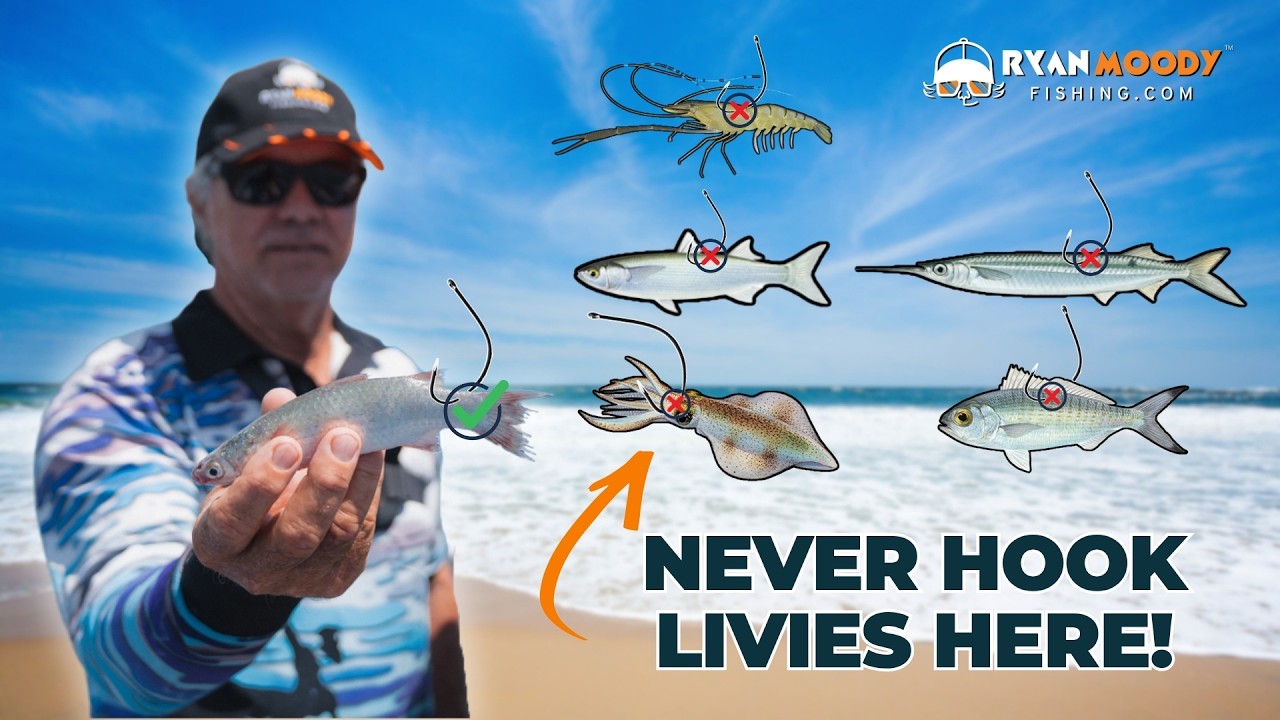
Most anglers who struggle with live bait are making one specific mistake, according to Queensland fishing guide Ryan Moody, and it starts the moment the hook goes in.
Moody's latest tutorial, published to his 150,000-subscriber YouTube channel, pulls apart the habit of hooking a livey once through the centre of the back and hoping for the best. The veteran Cairns-based guide walked viewers through mullet, garfish, milkfish and small pelagics in turn, arguing that each species needs its own pin point if the bait is going to swim the way a predator expects.
"A lot of people will just get a mullet or gar or whatever it is and just hook it in the centre of the back and hope for the best," Moody said at the top of the video.
The problem, he explained, is that a mid-back hook turns any live bait into a dead weight that spins in current and twists the leader rather than wriggling naturally. With larger mullet — anything from six inches upwards — Moody's preferred rig is a through-the-mouth placement, but not in the lip.
"Not in the very lip itself because it'll fall off every time," he said. "That's how we put larger mullet on for live baits because they hang aerodynamically in the current and they can wriggle around and look like a restricted bait, not just sit there and spin in the current."
The technique shifts completely for small mullet. Instead of the mouth, Moody goes to the very end of the tail, just above or below the backbone.
"They can still wriggle without spinning," he said. "It just means they're not through the mouth and hanging aerodynamically, but they'll still hang the opposite way and wriggle in the current."
Milkfish, a key live bait for big barramundi and other serious predators in northern Australia, gets the large-mullet treatment. Moody pins them through the mouth and out behind the top lip — "well behind the top lip, not the lip itself in behind it" — so a big fish can crunch down on an aerodynamic, lively target.
Garfish divide into two classes. Larger gar with long bottom bills are hooked inside the mouth, four or five millimetres behind the upper jaw, with the bill snapped off before deployment so it doesn't interfere with the strike. Smaller gar are pinned in the tail, just above the backbone, for the same reason as small mullet.
"So you either at the front for the big ones or the very back for the small ones," Moody said. "And that's how we rig our garfish."
The common thread through every species Moody covered is aerodynamics. A live bait that tumbles or spins is one a predator will ignore or short-strike, and no leader system or rod setup can fix a bait that presents incorrectly. The fix is cheap — it costs nothing more than moving a hook two or three centimetres — but Moody treated it as the single most under-appreciated detail in live-baiting.

Moody's channel has become one of the most-watched reef and estuary fishing resources in Australia, and the live bait video is tracking alongside his recent "6 Live Bait Mistakes" clip as a top-performing piece from the past month. The pattern is telling: even well-known techniques clearly have a broad audience of anglers still looking for a quieter, more technical read on the fundamentals.