Thirteen miles off the Maine coast, a crew of Vinalhaven fishermen spent this past winter doing something the island had put off for four decades: shipping out the traps.
Between January and April, the non-profit OceansWide and a rotating crew processed and recycled close to 5,400 derelict lobster traps from Vinalhaven — more than 170 tons of wire and plastic. Buzz Scott, who founded OceansWide and normally spends over half the year teaching scuba divers to recover lost gear from the seafloor, reckons the pile has barely moved.
"I think there's 60,000 to 100,000 traps on this island that need to be processed and removed," Scott told Maine Public.
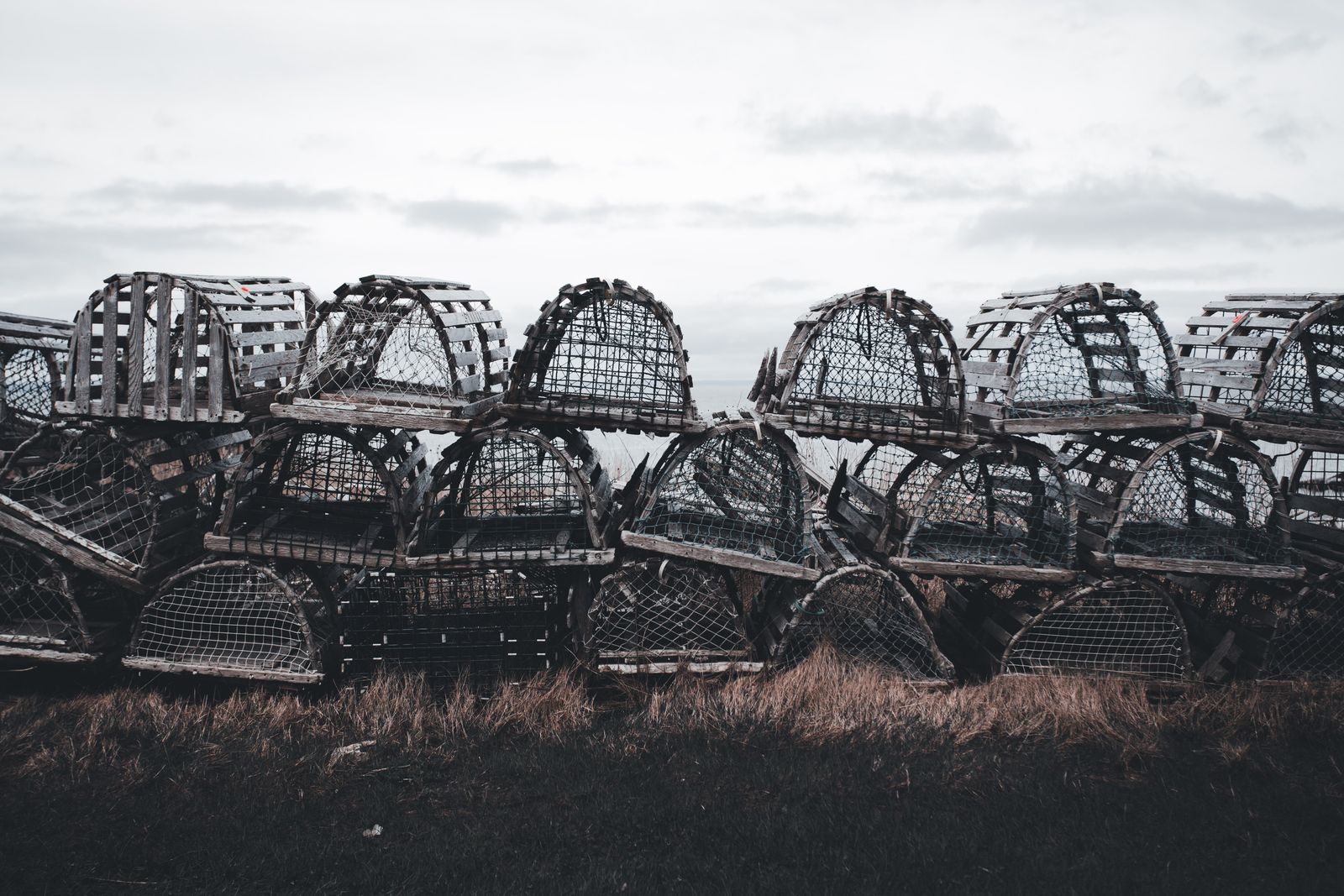
The root of it is a swap made in the 1980s, when wire pots sheathed in polyvinyl plastic replaced wooden traps. The old ones rotted away. The new ones sit in yards, in woodlots and on the bottom, shedding plastic and snaring wildlife.
Sending them to the dump is not much of an answer either.
"Guys can take the traps to the dump, and those traps go right into the landfill," Scott said. "If we take the traps, we pull all those plastic parts and pieces off, the aluminum parts and pieces, and we recycle those."
The teardown happens on an assembly line near the ferry landing. "Right now I'm the one with the clippers," said Beba Rosen, a Vinalhaven lobster boat captain. "I'm cutting out all the bricks from the traps, and then it moves on to someone else. And they'll take out the vents and all the other plastic is removed from the traps. And that gets sent to plastic recycling." Then the trap goes through a crusher and onto the ferry.
Persuading the fleet took some doing. Devyn Campbell, a Boothbay Harbor fisherman who joined the Gulf of Maine Lobster Foundation's programme in 2025, has fielded the sceptics.
"These old guys say, 'Oh, well, it just disappears. What are you doing that for?' And it's like, 'Well, it doesn't really. It just gets smaller.' That vinyl coating is all PVC. So that wears down, and that just turns into microplastics," Campbell told the Boothbay Register.
Offshore, the numbers get abstract fast. Roughly 3 million lobster trap tags are issued each year for the Gulf of Maine, and thousands of traps are lost annually, according to Laura Ludwig, who directs the Marine Debris and Plastics Program at the Center for Coastal Studies and works the ghost gear from Cape Cod Bay to the Bay of Fundy.
"There's millions of dead lobster traps on the Gulf of Maine bottom," Ludwig told ecoRI News.
The Gulf of Maine Lobster Foundation puts annual losses at 175,000 traps and the combined hit to the industry — forgone catch plus replacement gear — at roughly $16 million.
A lost trap keeps working. It goes on catching lobster and fish nobody collects, and about 90% of what ghost gear catches is commercially valuable, per WWF figures cited by ecoRI. The debris also fuses. Emma Weed, a programme manager at the Gulf of Maine Lobster Foundation who runs the Gear Grab effort alongside some 40 Maine fishermen, described what forms on the bottom.
"It's like a sea monster, and it will grab anything that's around it. It's usually rope, traps, all kinds of things that are all separate at one point in time. And through the tides and the currents, they wrap around each other. And then that can drag active gear into it," Weed said. The biggest gear ball recorded in the Boothbay region came in around 3,700 pounds; Weed says they can reach roughly 56,000.
Federal money is now behind the effort. William & Mary's Batten School of Coastal & Marine Sciences & VIMS runs the National Fishing Trap Removal, Assessment and Prevention (TRAP) Program on an $8 million NOAA Marine Debris Program grant, and has distributed $1.8 million to 13 organisations across nine states for work starting in January 2026. Round one funded 11 projects with $1.4 million and recovered over 7,000 traps — more than 300,000 pounds.
"We are thrilled with the initial results from our inaugural TRAP Program recipients. Their success is a testament to the impact that locally-designed solutions can have on global issues," said Kirk Havens, who directs the Batten School & VIMS Center for Coastal Resources Management.
There is a commercial case as well as an environmental one: a 2016 report cited by the programme calculated that clearing just 10% of the world's derelict crab pots and lobster traps would add $831 million a year to landings.
For the islanders, the reasoning is closer to home. Kelly Oxton fishes Vinalhaven and the nearby islands with her husband and picks up shoreline junk in her own time.
"We're just trying to make it look better and feel better. And feel better about ourselves, because who hasn't thrown something overboard?" she said. "This is our island; we don't have anything else. This is our industry, and if this goes we away — we're just trying to preserve what we have."
Over four months, more than 60 fishermen either delivered traps to Scott or asked his crew to clear their yards; some were too unwell to move the piles themselves. Curt Bryant, "Chief" to the crew, wants other harbours to follow.
"Hopefully it happens all the way up and down the state of Maine on the coast, everybody starts something like this, get it cleaned up," Bryant said.
The season is over and the crew is back fishing. Removal work runs from late fall to early spring — the Gulf of Maine Lobster Foundation shifted 45 to 55 tons along the coast from October, with Campbell managing 30 to 40 traps on a good day. At the rate Vinalhaven cleared its own yards, the island alone is a ten-winter job.