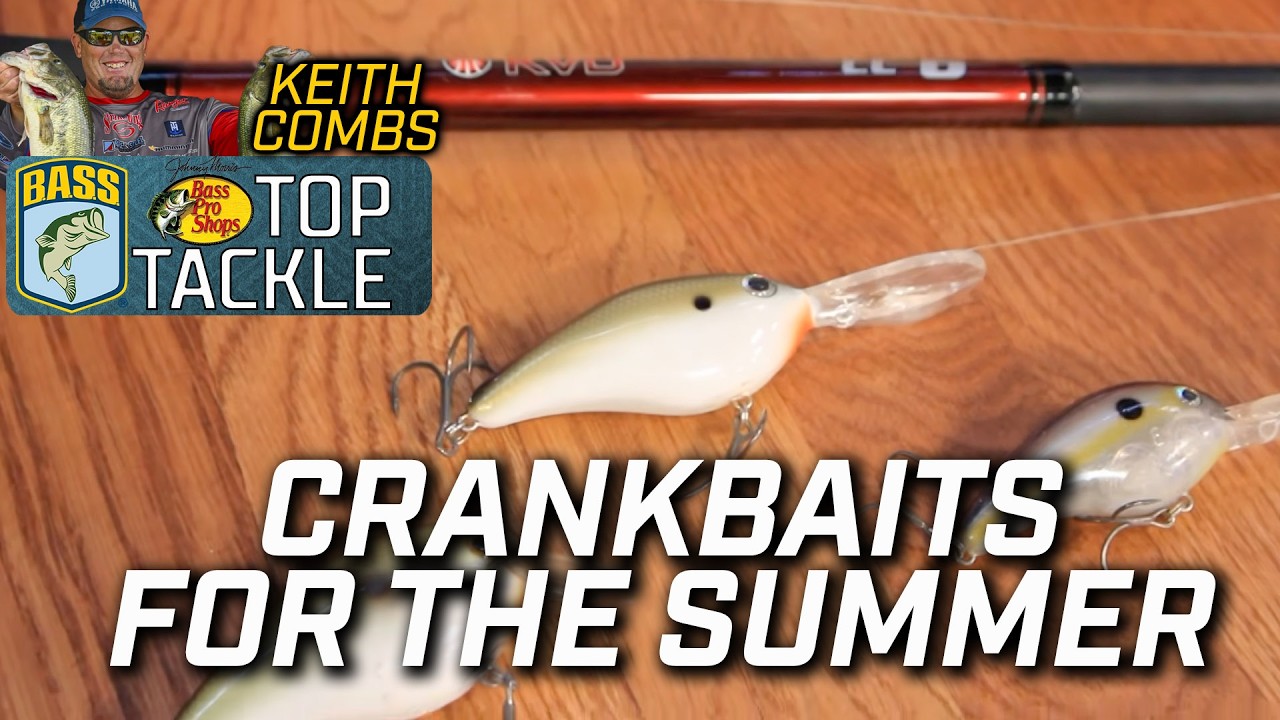
As summer settles in and largemouth bass slide off the banks to stack up on deeper offshore structure, few presentations cover water like a crankbait dragged across a hump or ledge. In a new breakdown filmed at the Bassmaster studio, Bassmaster Elite Series angler Keith Combs laid out the three baits he relies on most once the fish move out, and the message was simple: do not leave them at home.
"These are three styles of crankbait that I would not go into any offshore day without," Combs said.
First out of the box, and his clear favourite, is the Strike King 6XD. Combs leans on it in the 12-to-18-foot range, where it digs into the bottom and triggers strikes from fish that are not necessarily feeding.
"It's really going to get down there and grind along the bottom. It's going to get a lot of reaction strikes, but it's honestly a very subtle wobbling crankbait, so it's very realistic to a fish," he said.
When the bite turns finicky, Combs scales down to the 5XD, a slightly smaller bait with a marginally wider wobble that maxes out around 13 feet. "If the bite's tough, the 5XD tends to shine," he explained, slotting it neatly into the 8-to-13-foot band where slightly shallower structure holds fish.
The third choice is one Combs admits most anglers overlook offshore: the square-billed Strike King 4.0. Its wide body and square lip let it deflect off cover that would foul a round-billed diver, making it his go-to when fish are tucked into shallower brush.
"On shallower bars or around shallower brush, this is one of my favourite baits," he said. "It's going to come through brush and wood a lot better than your round bills will. So if you're getting hung up with your 5XD, switch up to that 4.0." The square bill dives to roughly nine feet.

His workhorse is a Lew's CC6 cranking rod, though he will drop down to a CC4 when fishing the lighter 5XD, paired with a Lew's Speed Spool reel. "I choose this reel because I want to have enough line capacity to cast these big baits," he said.
The through-line across all three baits is depth control and deflection. By matching the diver to the depth of the structure he is fishing, and stepping up to the square bill the moment he starts hanging up, Combs keeps a bait grinding bottom and bouncing off cover, the exact triggers that turn neutral summer bass into reaction bites. For anglers heading offshore as water temperatures climb, it is a tidy, three-bait system built around one rod, one reel and one line.