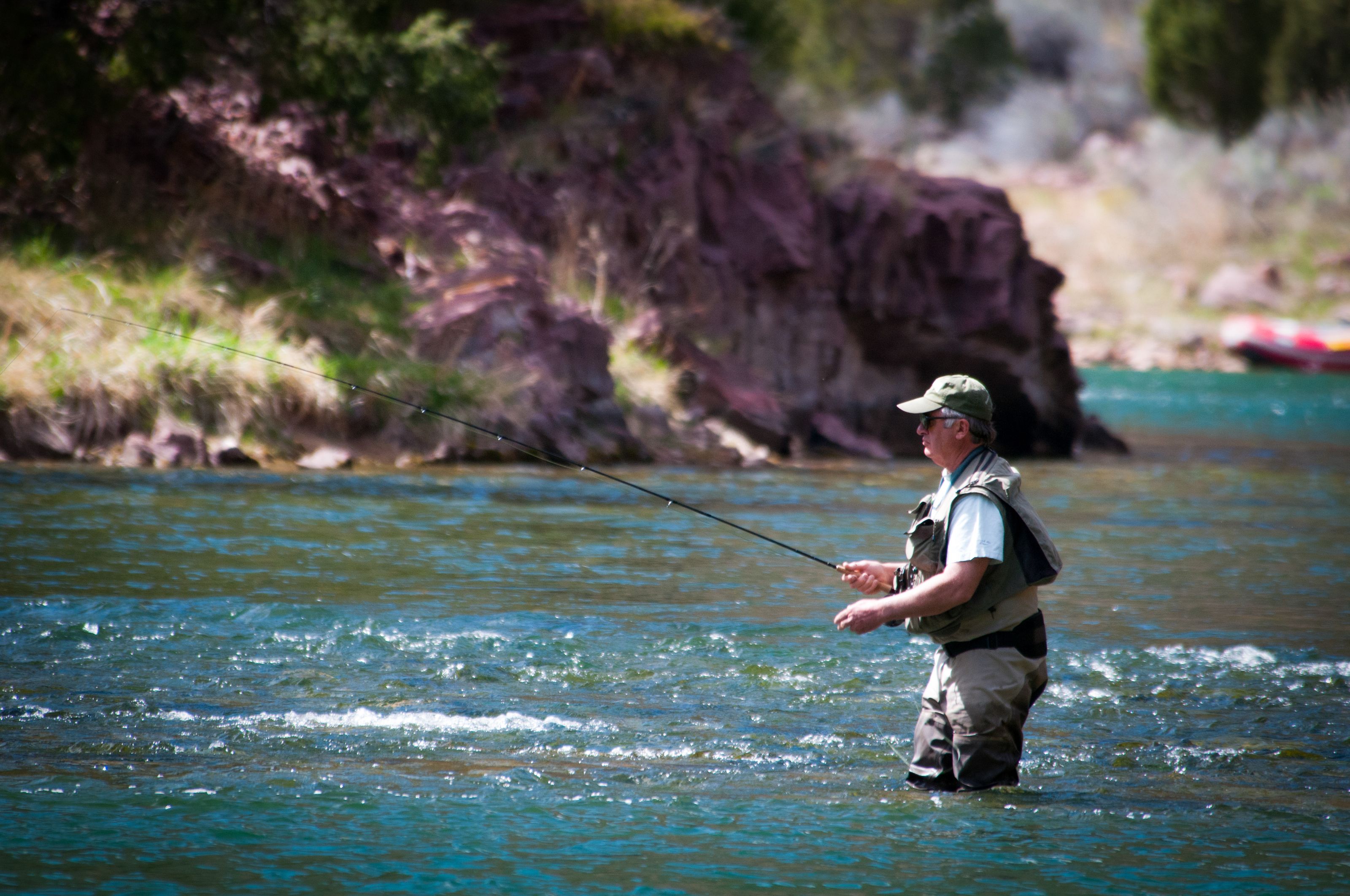
South Fork, Colorado, is named for a fork of the Rio Grande that usually runs cold and full through town, a Gold Medal trout stretch that draws fly anglers all summer. This year the river is running about 87 percent below normal, and the state has closed it to afternoon fishing.
It is not alone. Facing a punishing combination of low snowpack, drought and weeks of heat, Colorado Parks and Wildlife has placed mandatory or voluntary fishing restrictions on portions of 16 rivers and streams — nearly 460 river miles in all — along with closures on 10 lakes, ponds and reservoirs. On the Rio Grande, a voluntary closure now runs 74 miles from noon until midnight, the hours when warm water is most lethal to trout. The same story is playing out on the Conejos, the Animas and San Juan, the Dolores, the Colorado, the Elk, the Eagle, the Yampa and the Gunnison.
Trout come under stress when water climbs above about 70 degrees; on the Western Slope, daily highs have pushed past 71 with flows below half of normal. The sweep of closures is unprecedented in the 16-year career of Josh Nehring, deputy assistant director of the agency's fish management team, whose biologists weigh stream temperature, flow and dissolved oxygen before deciding whether to ask anglers off the water or order them off. "It's certainly taken up a fair amount of my job, reviewing what those decisions are and whether we want to go to a voluntary or mandatory closure," Nehring said. "We have seen a ramp up, I'd say, in the last two or three weeks for sure."
For guides, the timing has been brutal. Rick McGuire, who owns Wolf Creek Anglers in South Fork, says his business is down at least 35 percent. He stopped running river float trips about six weeks ago and later cancelled guided wading trips too. "Lower water, warmer temperatures, it can be a little more technical," McGuire said of a normal summer. "But not [like what] we're seeing right now. I don't have really anything to compare it to."
Down the road at Conejos River Anglers in Antonito, guide Micah Keys has been sending clients to nearby lakes after a morning on the river, and telling them to buy a stream thermometer. "Usually, most people that come in here, they want to keep this [fishery] for later use too," Keys said. "They've been understanding."
The picture is not uniformly grim. Where reservoirs have been drawn down so far that fish are likely to die anyway, CPW has done the opposite of a closure — lifting all catch limits so anglers can harvest as many fish as possible before the water gives out. And Nehring points out that the restricted miles amount to just 0.2 percent of Colorado's flowing water; higher-elevation streams remain cold and productive. "It looks bad, but there's a lot of opportunity out there too," he said.
The wild card now is the monsoon. Forecasters expect late-summer rain to lift flows, but John Livingston, public information officer for CPW's Southwest Region, says storms rolling over fresh wildfire burn scars carry their own risk. "We know from past experience, seeing ash and debris flows and post-fire rain events, the kind of fish kill events that can be associated with that," Livingston said. "It's a little bit of the give and take that could come with rains this monsoon season." Earlier this month, a CPW crew netted a rare population of cutthroat trout and moved it out of the path of the Gold Mountain Fire near Ouray — a reminder that in a drought year, sometimes the fish have to be carried to safety.