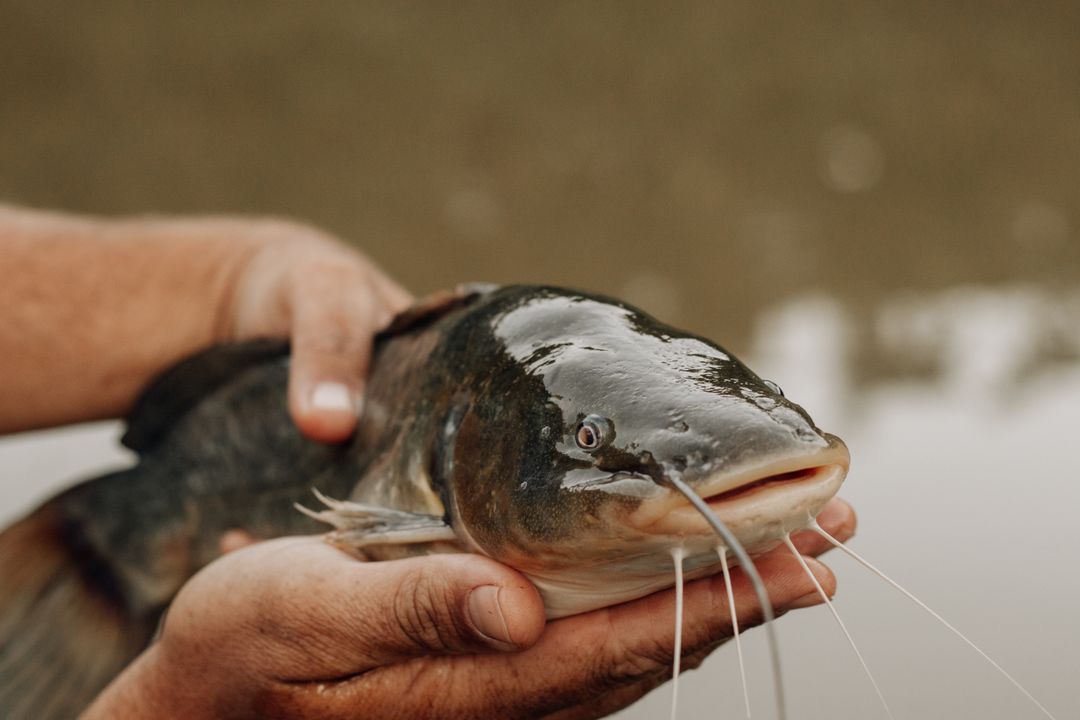
A fish that Virginia deliberately released into its own rivers half a century ago has become one of the Chesapeake Bay's biggest threats — and possibly one of its biggest economic openings.
Blue catfish, native to the Mississippi, Missouri and Ohio drainages, were stocked into the James River in 1974 and the York in 1985 to give recreational anglers a hard-fighting trophy. They reproduced and spread far beyond anyone's plans, eventually colonizing the brackish bay and pushing into the Carolinas and Georgia. Michael Schwarz of Virginia Tech's Seafood and Agricultural Research and Extension Center now estimates the bay holds 750 million to a billion pounds of them — more, by weight, than every other species combined.
"It's an uncontrolled invasive species that is eating all of our traditional species that our seafood industries rely on," Schwarz said.
Their appetite is the heart of the problem. In stretches of the York, Rappahannock and James, surveys put blue catfish at up to 75 percent of all fish biomass. Mary Fabrizio, a scientist at William and Mary's Batten School and the Virginia Institute of Marine Science, dissected nearly 7,000 of them and found the bigger fish steadily eating native oysters, shad, menhaden, herring and young blue crabs.
"They're really an eating and reproducing machine," she said.
Photographer Jay Fleming, who has chronicled the spread, has seen it firsthand. "They've gotten up into Maryland and down to North Carolina, and they eat everything," he told National Fisherman. "Crabs, oysters, mussels, clams. I opened up the bellies of some, and they are full of fish and shellfish."
"The more you eat, the more healthy the bay is," said Rachael Peabody of the Virginia Marine Products Board. "That's really something I think everyone's interested in capitalizing on."
Restaurants are buying in. Kyle Rowley, who runs the Virginia seafood chain Skrimp Shack, put the fish on his menus after noticing the species he grew up catching had grown scarce. Wild blue catfish, he points out, hunt in the open water column and taste cleaner than their farmed cousins.
"We've talked about saving the bay for my entire life," Rowley said. "This is actually something we can do."
Volume already moves through the supply chain. Nick Hargrove of Tilghman Island Seafood says his Maryland operation bought four million pounds last year. "Catfish is one of the top five most recognizable fish in the world," he said. "It's a great low-priced protein."
Still, the people who actually catch and cut the fish are squeezed. A working fishery needs watermen, processors and buyers expanding together, and cheap imports keep the price low. Meade Amory, whose Hampton seafood house is more than a century old, once turned catfish away. Now it is most of what he handles, and he is not sure the business survives another ten years.
"Families are on a budget," Amory said. "They can get a frozen catfish filet already breaded for cheaper than I can sell the whole fish right off the boat here."
The longer-term worry, says VIMS researcher Shelby White, is who will be left to fish at all. "The shortage of young people entering the industry is more problematic than the catfish themselves," she said.