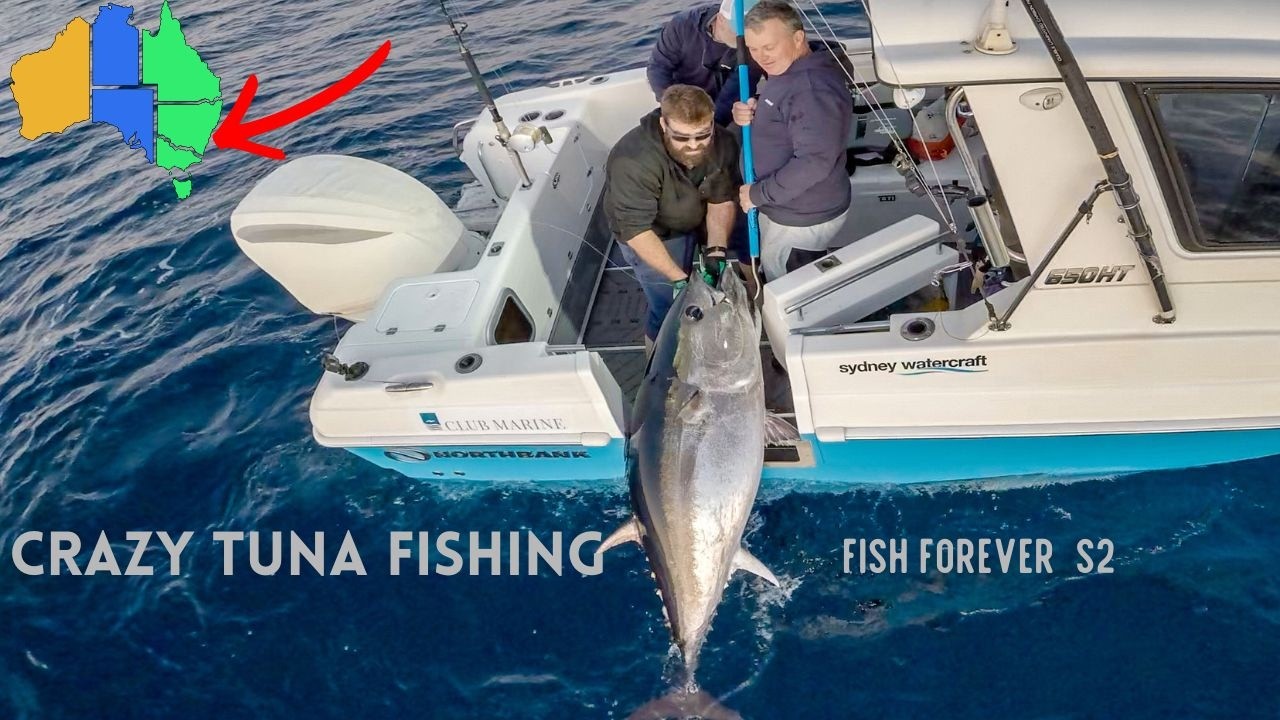
There are not many good-news stories left about the state of the world's oceans. The southern bluefin tuna is one of them, and presenter and marine advocate Al McGlashan headed offshore from Sydney to see the comeback for himself — and to put tags in fish in the name of citizen science.
The southern bluefin is a fish McGlashan has followed for most of his life. Growing up in Victoria, he never saw one despite his father's tales of catching them in the rip at the entrance to Port Phillip Bay. Everything changed in 2006, when a big bluefin was caught off Victoria's Shipwreck Coast. He dropped everything, drove straight to Portland, and ended up catching three huge fish as a bluefin fishery suddenly exploded across southern Australia.
"It is an amazing story about a fish that I'm so passionate about," McGlashan said of a species once driven to the brink by demand for its flesh. Coveted as a delicacy in Japan, a single bluefin can sell for thousands of dollars at auction, and that pressure pushed the stock to the edge. Yet recent assessments show numbers recovering so strongly that the southern bluefin is no longer listed as critically endangered. As McGlashan put it, this is the story of "how fishing actually saved the southern bluefin tuna."
The biology helps explain why the fish is so hard to find — and so worth protecting. Southern bluefin are the deepest-diving of all the tunas, regularly going beyond 500 metres, and they are extraordinary travellers. They are born in the only known spawning grounds, in the Indian Ocean between Australia and Java, then run down the west coast before fanning out through the Great Australian Bight, across to Tasmania and up the east coast, before turning around and making the entire journey back. Some run the gauntlet all the way to South Africa. They are also remarkably long-lived. "With your southern bluefin tuna, they're long-lived for 40 years according to some of the data, which is incredibly old," McGlashan noted, contrasting that with a yellowfin that rarely lives past five or six.
Over three glamour weather days off Sydney, the crew trolled vast stretches of empty ocean before the fish switched on. As is so often the case with tuna, the action came at sunset — "prime time, tuna style," when bluefin use the setting sun to ambush prey. The boat erupted with hooked fish, including a true fish-of-a-lifetime battle that ran the crew into fading light before it was landed.
Most of the fish were tagged and released with small dart tags, though two were kept — one perfectly hooked specimen that swallowed the lure, and another the family harvested for the table. "It's something that's really important to us as a family, that we harvest a fish and eat it as well," McGlashan said. "It's citizen science, but it's also feeding the family."
The data those tags generate is the real prize. While dart tags often fall out of marlin and other species, bluefin hold onto them remarkably well. "With bluefin, we've had fish recaptured up to 20 years after the tag was put in," McGlashan said. "This is phenomenal data, and it's something that we really want to learn a bit more about."
Anglers covering their own costs to be on the water, day after day, searching for fish to tag, are central to that effort. For McGlashan, the bigger lesson is one of hope. "We may have got it wrong in the past, but if we all work together, we may just be able to turn things around so that we can ensure we all have fish forever."