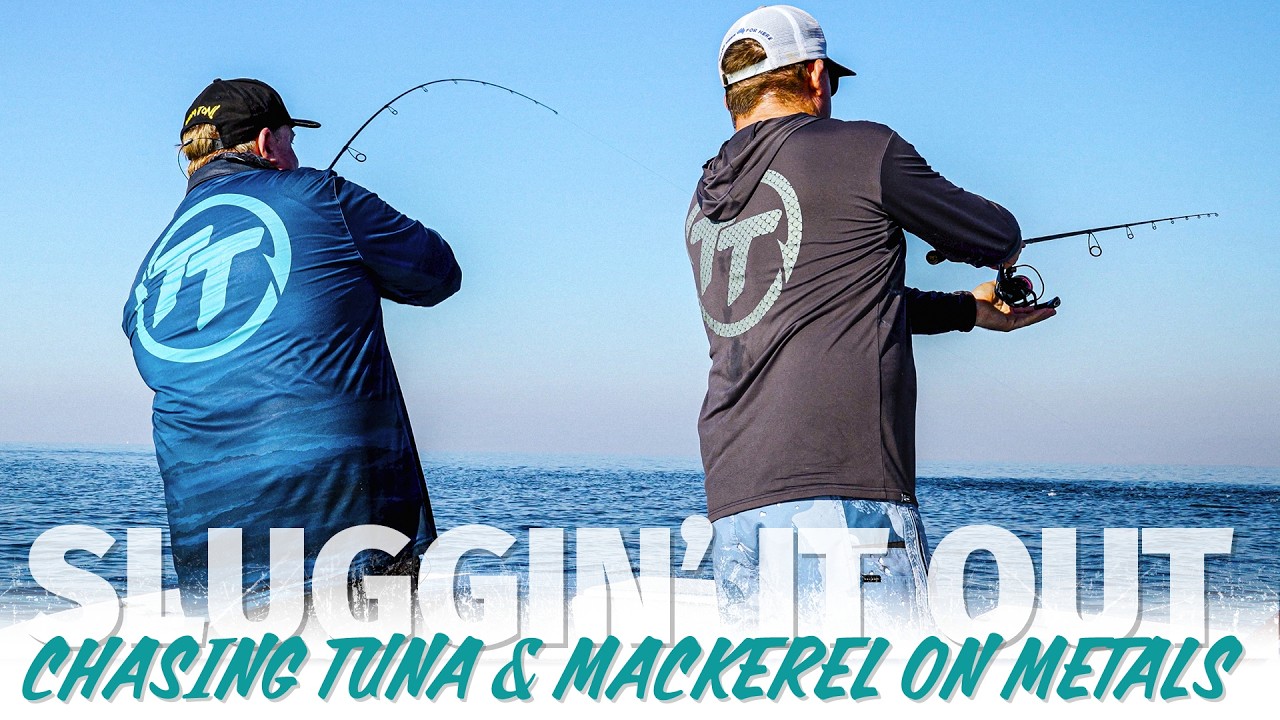
When pelagic species lock onto tiny bait, the answer is rarely a bigger lure. That is the premise the Tackle Tactics TV crew tested on a pre-winter morning in Moreton Bay, and it is the premise that paid off — a brand new 10-gram slug pattern broke a school of finicky mac tuna open and led the boat through a beacon-by-beacon hunt for school mackerel before the wind chased everyone back into the river.
The gear matched the target. Three-to-six kilo rods, a 4,000 reel and 20-pound braid carried a new 10-gram ZMan hardcore slug and a new 10-gram sway bait. The cast was straightforward — drop the lure in front of the boil, burn it through the school, hold on.
"It's always worth bringing a few different rods because sometimes the tuna are small and you got to throw 10-gram lures at him," one of the presenters told the camera as the first mac came aboard. "Light gear, 10-gram slugs… these little guys can be so fussy sometimes. That's why it's always worth having 10-gram lures in your kit."
The first hour produced a double-up and a steady flow of mac tuna onto ice, kept for use as bait further down the line. With the tide approaching slack, the school refused to bail bait up the way it normally would, and the crew had to keep moving with the fish.
"These guys like to push bait into the wind or push bait into the current," the presenter explained. "But with this slack tide, they're kind of moving fairly quickly, chasing bait, not bailing it up into those conditions. So we just got to keep moving with them, find them, and then we'll spin up a couple."
The morning was not without drama. A solid hook-up around a beacon turned into a long, head-shaking run that ended with the worst possible outcome — a shark eating the fish on the leader. "One of the endangered sharks has eaten our longtail. That was a big fish," the presenter said, before resetting at the next beacon.
The other half of the day's story unfolded around Moreton's marker beacons, where school mackerel were stacked tight to the bottom on the sounder. The tactic the crew leaned on was the same wherever they went: cast upstream of the structure, let the slug hit the bottom, then burn it straight back to the boat.
"We're casting out, letting it sink down to the bottom. Soon as it hits the bottom, that line will go slack and it's just a fast retrieve back. A lot of those fish will bite it just before the slug gets to the surface," the presenter explained. The mackerel often sat in plain sight around the boat without committing, which forced another downsize. "A lot of the time with pelagics, if you can't get a bite, downsize. So I've changed down to that 10-gram slug. And on that first drift, he's come up. A bunch of his mates come up. But yeah, that down straight away got a bite."
A school mackerel landed clean, several mac tuna chilled for fresh bait, and a giant Spanish mackerel briefly cruised through the bait on the surface — a 20-kilo fish, the presenter estimated, that bit a slug in half before disappearing.
When the wind ramped up, the crew abandoned the offshore plan and ducked into the river mouth. A ghost chartreuse three-inch slim swimz on a quarter-ounce demon jig head produced a pair of flathead — the same rod, the same reel, two completely different fisheries inside a session. For anglers eyeing the glassy winter mornings in southeast Queensland, the message is simple: keep a tray of 10-gram slugs in the kit, hunt the beacons after the bust-ups slow, and keep a backup soft plastic ready for the creek.