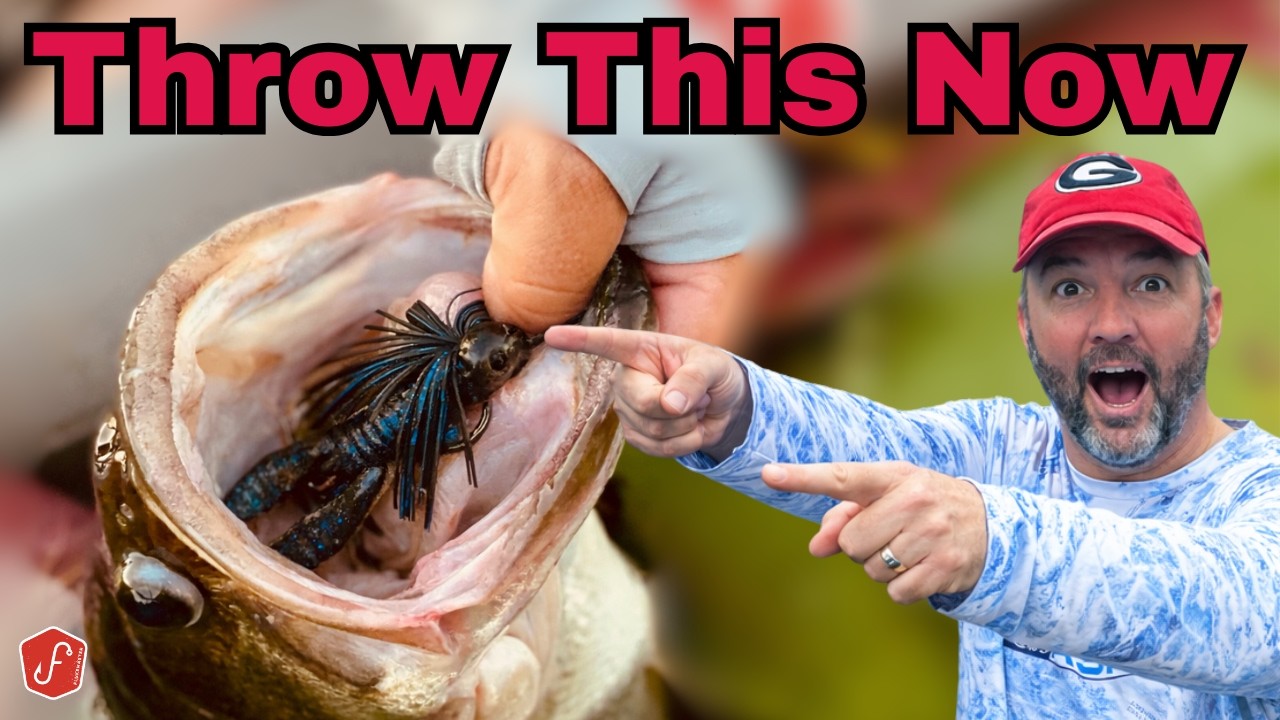
Gene "Flukemaster" Jensen's latest spring bass tutorial comes down to a single question: when you're standing on the bow and the fish are moving — pre-spawn here, post-spawn there, the weather changing by the hour — which bait is still catching the biggest largemouth in the lake? His answer is the flipping jig, fished painfully slowly, in the thickest cover an angler can physically force it into.
"Spring fishing is just weird because the fish are always moving," Flukemaster explains. "They're trying to go up to spawn, they're leaving from spawn. You got pre-spawn, post-spawn, middle-spawn fish and it leaves a lot of us guessing."
"We rotate through all kinds of moving baits and all kinds of reaction baits," he adds, "and we forget that sometimes you just got to slow down. The fish are there, they want to bite and especially the big ones, they're just not willing to move far to get it."
Why a jig, and why now? Flukemaster lists three advantages: imitation, strike-zone time, and access.
"A jig imitates a crawfish or a bluegill and those are both primary food sources for a bass that's getting ready to spawn and or trying to feed up after the spawn," Flukemaster says. "The bigger bass will key in on the larger crawfish and those 3 and 4-inch bluegill."
A jig fished on a laydown can sit in the sweet spot for four or five seconds at a time. A jerkbait or crankbait sweeps past in fractions of a second.
"Because you're fishing it considerably slower than like a crankbait or a jerkbait or anything like that, you're able to keep it in the strike zone longer," Flukemaster says. "A lot of times those fish aren't willing to move very far or chase your bait."
Third, it gets into cover that reaction baits cannot fish. Flukemaster is pointed about the importance of not dialling down the cover quality.
"Don't be scared. That's a big mistake that we make. Do not be scared to throw this thing into thick cover," he says.
Jig selection matters. Flukemaster is specific that this is not a season for a football jig — even though he calls himself a "football jig freak." His go-to flipping jigs are Strike King structure jigs for moderate cover and handcrafted LS Lures flipping jigs for the heaviest wood.
"This is not the time for a football jig, and I'm a football jig freak," he says. "But I love to fish offshore structure. This time of the year, they get tied into that shallow cover."
The technique he prescribes is a three-step anti-reaction-bait sequence. Flip the jig alongside a laydown or stump. Let it sink fully. Count two, three, four seconds. Shake the rod tip without actually moving the jig. The fish that followed it down on the drop, he says, will commit on the shake.
"Let it sink to the bottom, count to two or three, four seconds and then just shake it without moving it," Flukemaster says. "A lot of times these fish are a little bit up off the bottom. They're suspended, especially in a little bit deeper water. And that jig comes past them and goes down."
Another presentation he flags as under-used is shaking the jig on the limb of a laydown before dropping it to the bottom: "Before you pop it over that limb, just hang it on that limb and shake it a little bit. A lot of times you'll get bit right off of that limb."
The rest is a confidence problem, which Flukemaster acknowledges every time he commits a cast into wood he's nervous about losing a jig in.
"I'll hook him first and worry about the rest later," he says. "Get it into that thick cover."
It's a message worth repeating in a finesse-sonar-saturated 2026 bass scene: the biggest fish in the shallows are the ones not willing to move. A slow-shaken jig is the only presentation that asks them to move exactly that far — no further.