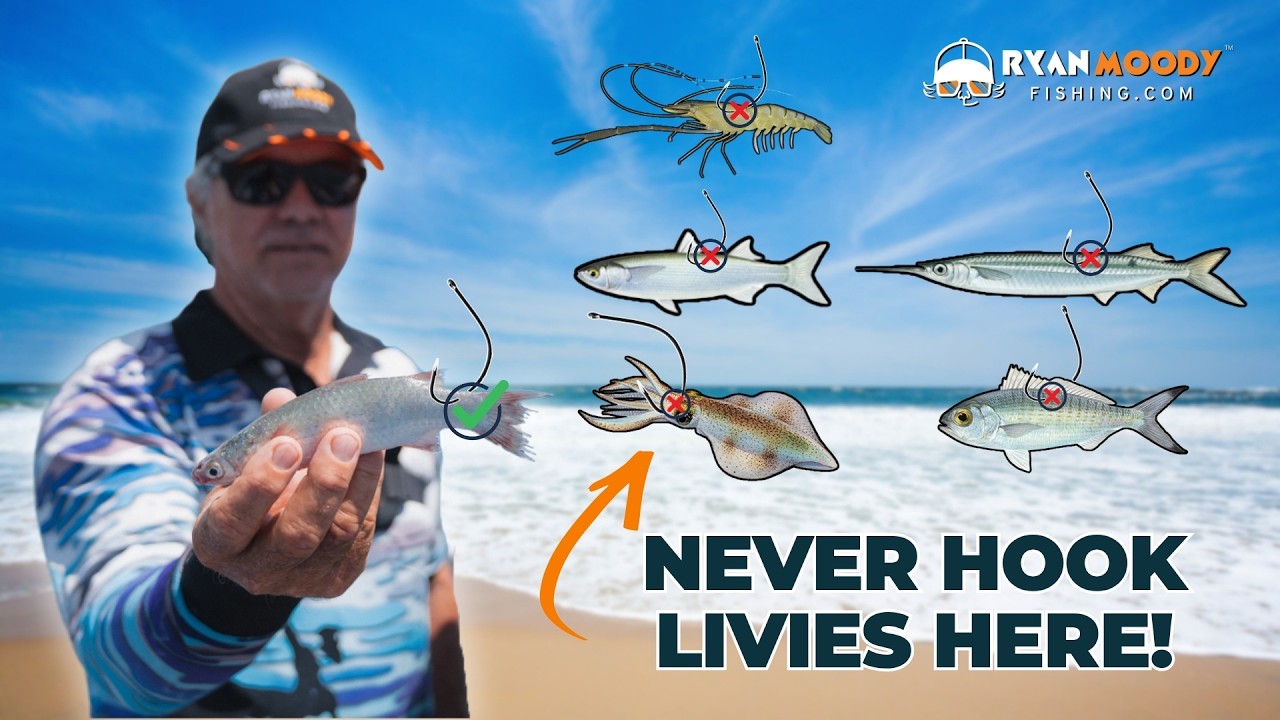
The detail most anglers get wrong with live bait is the simplest one to fix: where the hook goes in. Queensland fishing guide Ryan Moody's latest tutorial, fresh to his 150K-subscriber channel, puts a clear line through the middle-of-the-back hook and replaces it with species-specific placements that keep the bait lively and aerodynamic in the current.
"A lot of people will just get a mullet or gar or whatever it is and just hook it in the centre of the back and hope for the best," Moody said.
The consequence, as he walked viewers through, is a bait that stops looking like a bait. It spins in current, twists the leader, and gives any nearby predator an obvious visual cue that something is off.

For mullet six inches and up, Moody pins the hook through the mouth, but crucially not in the lip.
"Not in the very lip itself because it'll fall off every time," he said. "They hang aerodynamically in the current and they can wriggle around and look like a restricted bait, not just sit there and spin in the current."
Small mullet get a different treatment — a tail-end pin, either side of the backbone at the base of the tail.
"They can still wriggle without spinning," he said. "It just means they're not through the mouth and hanging aerodynamically, but they'll still hang the opposite way and wriggle in the current."

Garfish split into two camps. Larger gar are hooked inside the mouth, four or five millimetres behind the top jaw, with any long bottom bill broken off before deployment. Smaller gar match the small mullet pattern, pinned above the backbone at the end of the tail.
"So you either at the front for the big ones or the very back for the small ones," Moody said.
The principle running through the video is aerodynamics. A bait that sits right in the current is a bait that gets eaten. A bait that rolls or spins spends its life pretending to be something a fish wants nothing to do with. Moody presented the fix as a small, nearly free adjustment — move the hook two or three centimetres — but treated it with the same weight as any rigging question the rest of the sport obsesses over.

His channel's recent run of bait-focused content — "6 Live Bait Mistakes" last month and now the full species walkthrough — is quietly one of the better practical education resources for Aussie anglers chasing reef and estuary fish, and the audience is showing up accordingly.