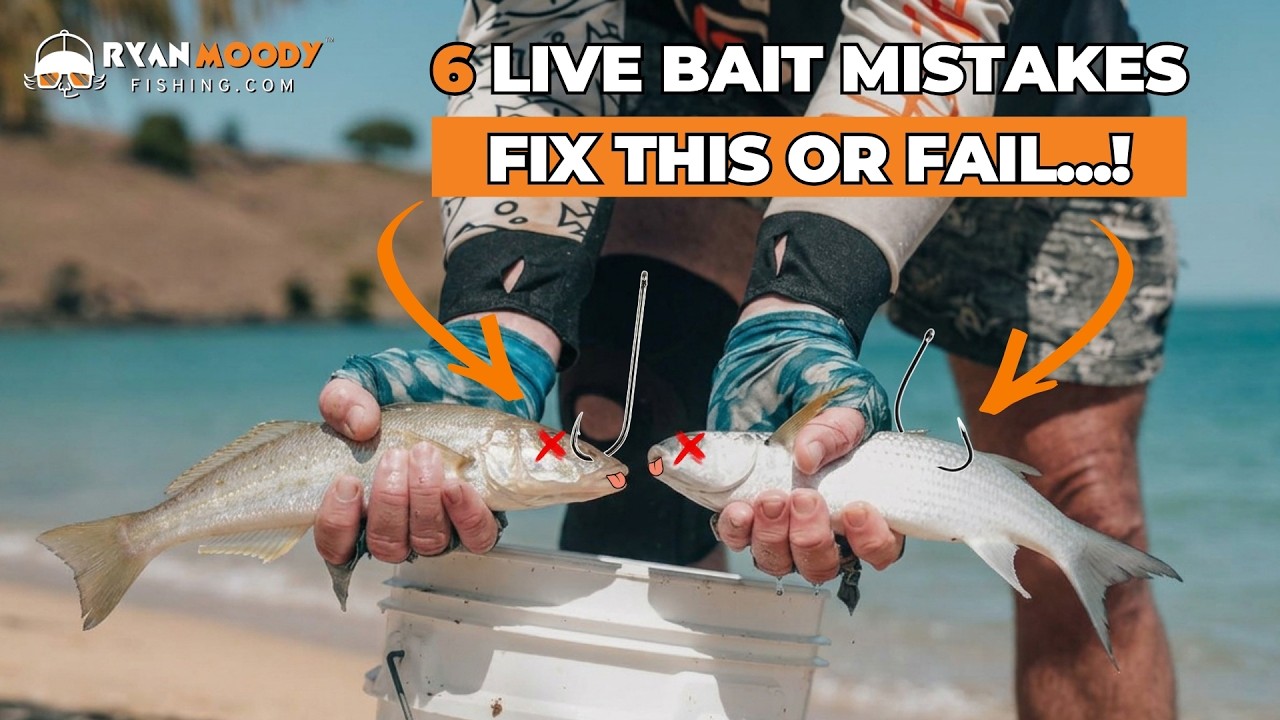
Long-time Australian charter operator Ryan Moody has turned a new tutorial on his YouTube channel into a six-point checklist of live-baiting errors, arguing that the difference between a productive day on the water and a frustrating one often comes down to bait care and hardware choices rather than location.
"Live baiting is one of the most effective ways to catch many trophy fish," Moody told viewers. "And after four decades on the water, I see people make a lot of mistakes."
The first error he highlighted is oversized hooks on small baits. Demonstrating with a 10/0 circle hook, Moody said that style is only appropriate for much bigger live baits. Forcing it through the tail of a small livey, he said, rips a hole so large the bait flies off on the cast. For small mullet, his recommendation is a 5/0 or 6/0 at the most.

Next is rigging position. Moody pointed to mid-back pinning as a persistent problem. "That is not aerodynamic whatsoever," he said. "If you hook baits in the middle of the back, they just sit there and they spin in the current." Herring and similar species tolerate nose or eye-socket rigging, but smaller mullet perform far better hooked through the tail — just behind the backbone rather than on top of it.
He then warned that the nose-hook technique many anglers learn on big baits does not transfer downwards. "These smaller baits don't have that kind of affordability to be able to put a hook in there," he said, describing the thin tissue between the nose tip and eye socket on small mullet as insufficient to anchor a hook for a casting load.
Bait handling is the next battleground. Moody called out anglers who leave their cast-netted bait on hot sand while they rig up. The combination of heat and abrasion strips scales and weakens the bait within minutes. "They need to be put straight into fresh, oxygenated salt water immediately," he said.
The fifth mistake extends that theme into the bait tank itself. Overfilled tanks force fish against the walls and each other, shedding scales and depleting oxygen. The outcome is fewer lively baits when it matters, and more floaters inside the first hour of a trip.
Moody's final point targeted hardware mismatch. Long-shank hooks intended for chunk or strip baits, he said, are a poor fit for live baiting because predators treat a live target differently. "It really brings out the predatory instincts in fish, they generally smash it whole. Whereas chunk baits and that, they generally come up and pick away at it." When the predator takes the whole bait, the long shank often sits in the wrong position for a clean hook set.
The video closes with a plug for Moody's online course on finding live baits through the tide — but the take-home is practical and cheap to action: right-sized hooks, tail hook-ups for small mullet, cool water straight from the cast net, a lightly stocked tank and the correct live-bait hook pattern.