Neap tides divide the Australian inshore crowd. Half the country's mangrove anglers read a tide chart, see three metres of run turn into 30 centimetres, and stay home. Sportfishing Junkie has spent enough sessions on Hinchinbrook's forest creeks to argue there is a better use of the same chart — and his latest video lays out a five-point system for catching barramundi and mangrove jack on the weakest tides on the calendar.
"Those tides are pretty neap today," he told viewers up front. "I just wanted to go through five little strategies that I use that, if you use, can help you catch more fish during neap tides."
The first rule is that "neap" is never truly zero. "No matter how neap the tide, there will generally always be movement somewhere in the tide. So have a look around. Spend some time looking around and you'll find that even though it'll only be slight, there will be some pressure points and little areas," he said. Outer bends, feeder-creek entrances and the first hour past the tide turn are the three structural targets.
The second rule is to borrow a lesson from freshwater impoundment fishing: when the tide can't feed the fish, the wind will. "Use wind to your advantage. This bank here, you can see even though there's not much run, there's wind pushing on there and it's creating disturbance. That'll be pushing bait and food around for these fish," he said. Surface chop also solves the second great neap-tide problem — water that has cleared up. "Quite often during neap tides the water clears up and that can be a real problem. That little bit of disturbance on the top of the water can hide you from the fish."
Rule three is a reluctant concession for frog-throwers: drop below the surface. "Fish aren't going to move very far," he said. "They're not generally going to want to move as far as they would if there's a little bit of green tinge or a little bit of dirty water every now and then." A shallow-running subsurface lure with a short pause, rather than a Billy Goat topwater, fits the mood of neap-clear water.
Rule four is about position, not tackle. Fish hold on the fringe of the mangrove roots, not deep inside them. "The water doesn't go very far back in," he said. "It's just deep enough that the fish will feel a little bit comfortable in moving into the edges of the mangroves, but not too deep that they're going to go a long way back and get out of range." Skip-casters who have been burning casts deep into dead water are casting at ghosts.
Rule five is time. "It will be a grind and you're going to need to cast, cast. You're not going to be able to escape that," he said. "Fishing is so much about confidence. Putting in the time and understanding whatever fish you're chasing, whatever area you're fishing will result in more fish."
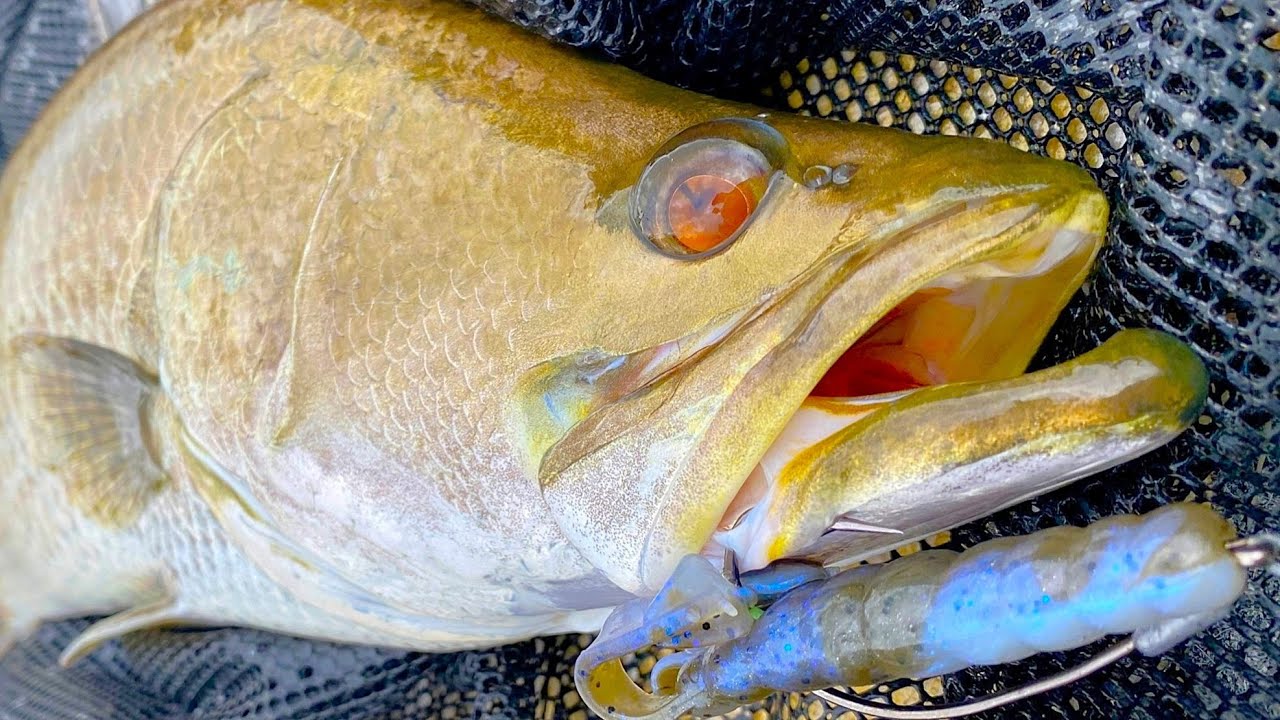
The fish came. A 40 cm mangrove jack pulled tight at the start of the session. A second red dog was plucked from a shaded nook at midday. Then, on the final run of the day, a 66 cm barra climbed on a snag to eat and buried itself back in the timber before being prised out. "Neap tide barra in the groves, in the forest," he said. "Sixty-six of Hinchinbrook's finest mangrove forest barra."
The weekend-hack argument lands at the end. "Often you don't get a chance to fish a perfect tide. You just fish what you can fish." Five small rules, one proof-of-concept barra and a half-day of casting — the neap tide turns out to be a workable window after all.