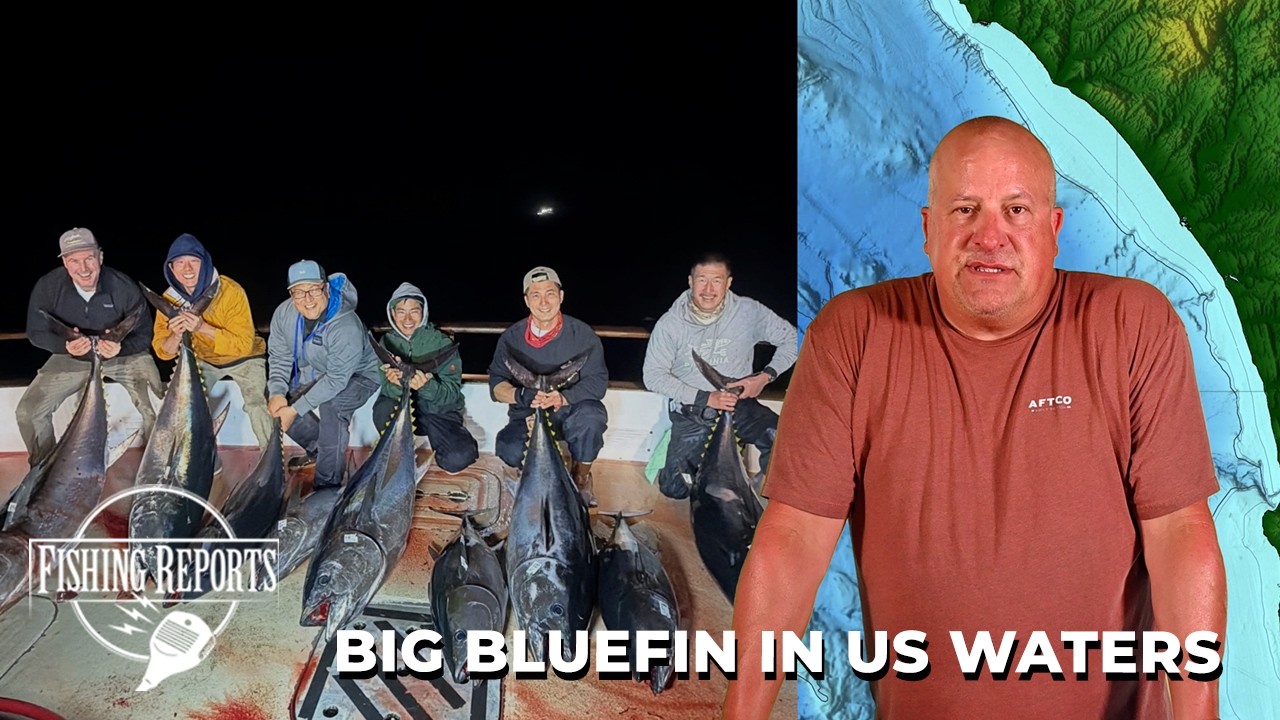
BDOutdoors' weekly Southern California Bight update for the Memorial Day weekend opens with the breeze, but the headline is buried halfway through the report. Bluefin tuna have moved back into United States waters off the back side of San Clemente Island, and the deep-water calico and sandbass game is now switched on from Santa Barbara to the Mexican border.
The weather window through the long weekend is the first item on the agenda. "It's been kind of a breezy week here for the most part," the presenter explains. "A lot of different wind directions on every day, but it's definitely been blowing." The good news is a familiar SoCal afternoon pattern returning. "We have calm weather in the mornings followed by just the afternoon west winds that are typical this time of year. So sport boats should be fine wherever you go. Private motors — if you're going somewhere far and you have a center console, I'd recommend leaving before the wind starts blowing."
Further offshore, the story is more interesting. Long-range fleets running out of San Diego are already on a solid grade of bluefin off Clemente, and the report flags a likely expansion of the fleet from northern ports through the weekend.
"The big news in offshore fishing is that the bluefin have moved into US waters," the presenter says. "There are a good grade of bluefin being caught off the backside west end of Clemente… all the pressure has been in one area, but the area that those fish are in is pretty similar to the area it's been in for last few years. Once boats start running out of Long Beach or San Pedro or Redondo or Marina Del Rey, they're going to be coming at different angles. And if it's day boats, I think they'll probably find fish closer than that."
Most of the fish, he adds, are being landed at night, with the long-range and reverse day-and-a-half boats taking the lion's share. "I'm sure the boats will be out there this weekend flying kites and flying fish and catching all kinds of giants," he says. "It's good to see them up there already. And hopefully they stick around and bite."
"Calicos and sandbass are biting on deep water structure spots," he says. "And this is good now, continue to get better as we get into summer. You can fish big spots, you can fish small spots, whatever you want to do, but you're going to need your fish finder to find the structure, your chart to find the structure."
On small isolated pieces — a 10-foot rock, a wreck, a single reef — he describes the game as positional. Drop a swimbait on a heavy lead head over the top and the bass come up to eat it. On large pieces of bottom like Eve's Reef or the Santa Ana River pipe, he argues, finding the biomass means hunting bait rather than marks.
"If I'm fishing a big piece of structure, be it a submerged pipe, a big reef like Eve's, a large area of hard bottom, I'm not necessarily looking for bass marks," he explains. "I'm looking for bait balls because the bass, if they're feeding, are going to be wherever that bait is. So you drive around and you find bait on the meter and you drop your lure. And if you watch the fish finder a lot of that time, you can see your lure going down. And then right after you drop to that bait school, you'll see a bunch of bass come up off the bottom."
For kelp-line bass fishing closer to shore, the report leans on a windy local session out of Point Fermin around to Torrance, where seven-inch MC slug bodies on weedless and weighted keel hooks did most of the damage on isolated stringers outside the main beds.
The report's most pointed moment is not about fish at all. The presenter dedicates several minutes to pushing CCA's Sacramento advocacy fund, arguing that California's fishing rights are 'truly in jeopardy' and that the work that matters happens in committees and working groups long before public meetings.
"Ninety percent of these fisheries decisions are made long before they have public meetings," he says. "CCA works behind the scenes — we're on working groups like the Barred Sand Bass working group collecting data for them, for the Fish and Game Commission, because they don't have the resources to collect their own data. And rather than take data paid for by the NRDC or these other organizations that don't want you to fish, we are advocating for angler-driven data and they are accepting it if we turn it in."
The CCA Star Tournament also runs from Saturday through Labor Day, with a 17-foot Mako boat and a $3,000 Shimano shopping spree on the prize table. Sign-up is $40 for CCA members.