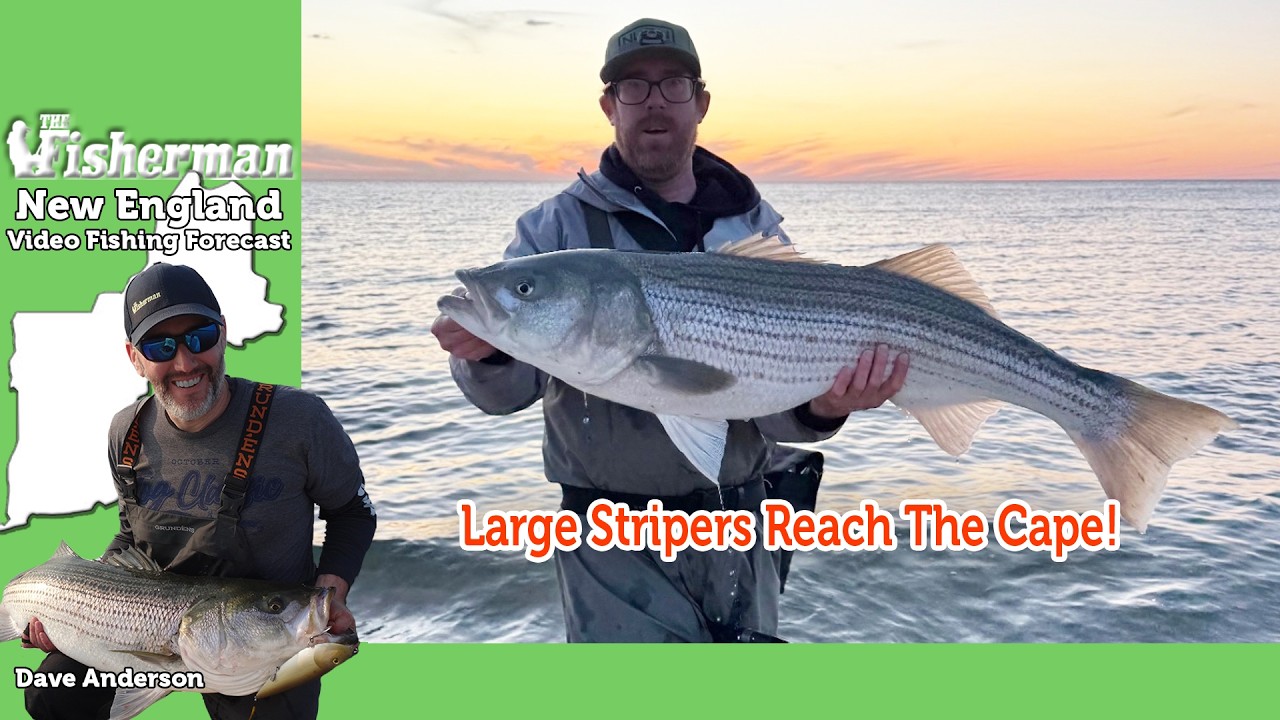
Dave Anderson's May 14 New England Forecast for The Fisherman magazine arrived with one of the cleanest week-one striper paragraphs of the year.
"This week it's all about the striped bass," Anderson said. "We have had 40-pound stripers reported from all three southern New England states. We have migratory fish now arriving in southern Maine. There's been incredible catches across the region with average sizes that are far exceeding what we usually see this early in the season."
The report's second anchor is the Saturday sea bass opener. Both Massachusetts and Connecticut reopen black sea bass on May 16 with four-fish limits - a 16-inch minimum in Massachusetts, 15 inches in Connecticut. Anglers near the Rhode Island line should watch the drift.
"You don't want to drift into Rhode Island waters because Rhode Island doesn't open up until May 22nd," Anderson said.
The state-by-state striper detail is the real meat of the report. In southern Maine, fresh migratory fish are pushing into tidal rivers including the Mousam, Saco and Kennebunk in a 10-to-15-pound class with a few above. Plum Island's biggest fish are concentrating around the mouth of the Merrimack at 17 to 18 pounds. A larger push has just moved into Boston Harbor.
"A good push of fish has now moved into the Boston Harbor area," Anderson said. "These fish are in the 15 to 20-pound class. Might be a couple pushing north of that."
On the freshwater side, the central Massachusetts lakes are still producing lake trout on the Wachusett system, smallmouth on Quabbin and Wachusett, and largemouth out of the Chew. Anderson is watching the spawn lag.
"I do suspect that being that these lakes are so big and so deep and so cold, the spawn may lag behind a little bit," he said.
"Everyone's kicking their season off with bigger fish than normal," Anderson said. "And everyone's fired up."
The lure feature is a new size of the Yo-Zuri Hydro Twitchbait. Chris Bishop, Yo-Zuri's vice president of sales and marketing for North America, joined Captain Rob Radloff's Conch 27 with Gray FishTag Research and put the new 7.5-inch, just-under-five-ounce slow-sinking version through its paces on the New York Bight.
"Slow sinking bait with a wide wobble, natural action, kind of a roll to it," Bishop said. "What I really like about it is you could slow it down, twitch it, you can burn it, you can really slow roll it. Basically do anything you want with it. And the profile is the key. That bigger bunker profile."
Bishop's cadence read changes by conditions. In April's high-40s water with bunker around, a straight retrieve produced. On a flat where fish are holding on the bottom but not actively feeding, the pause-and-twitch did the work.
"Give it a couple cranks, get it to swim, and then pause it. Give it a couple hard twitches and they eat it on that pause and twitch," Bishop said. "What I'm trying to do is run it across their face with an erratic action and then kind of pause it in front of them and they got to eat it. It's more of a reaction bite."
Bishop, a Florida snook angler by background, has become an unlikely Northeast striper devotee.
"They're quickly becoming one of my favourite fish in the world," he said. "They're not the hardest fighting fish pound-for-pound by any means, but they hit hard. They travel in big schools."
Offshore, the Canyon Runner crew's read is the second tactical anchor. A rotating Gulf Stream plume has pushed north over the Washington Canyon, Poor Man's and the Baltimore for five days. Boats out of Oregon Inlet and Norfolk have started catching bluefin and yellowfin on the edge. Tile fishing trips in the Hudson Canyon are producing incidental bluefin hookups on the bottom rig.
"Guys working this water are catching bluefins, and there have been some yellowfins, and that should just get better and better," the Canyon Runner host said.
With surface temperatures at 68 to 69 degrees on the edge and the Hudson dropping warm water inshore, the New England weekend list is generous - oversized stripers in all four states, a Saturday sea bass opener at the Mass-Connecticut line, fluke firing in Rhode Island, and a 7.5-inch slow-sinking twitchbait that has lined up perfectly with the bunker class running the coast.